
Welcome!

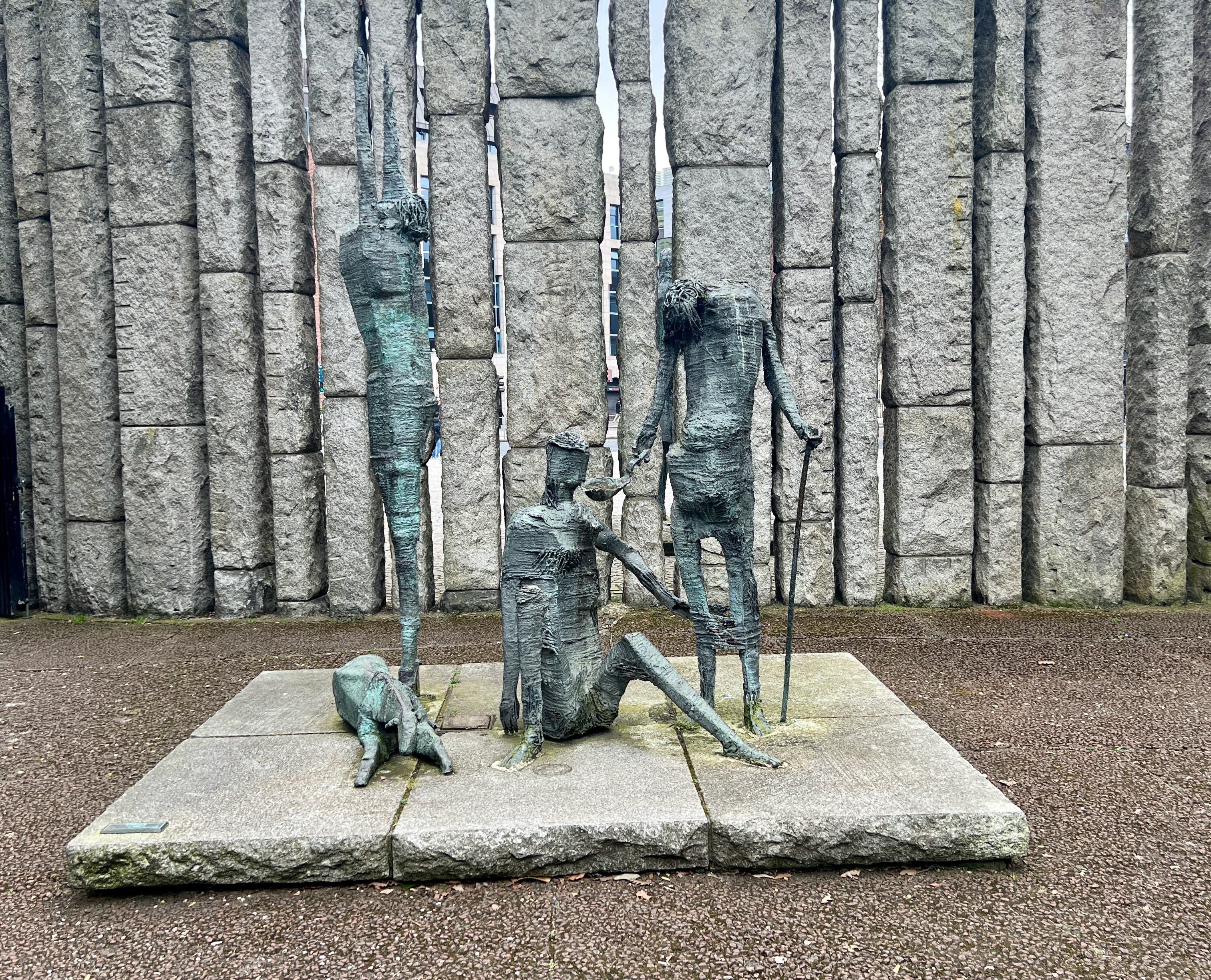
Welcome to Shadows of Hunger. In this newsletter, I’ll explore the history and legacies of Ireland’s Great Famine (1845–1852) and the resulting diaspora to North America. While I’ll touch on the Famine’s broader historical context, my main goal is to document the lesser-known, local histories of the crisis, particularly those of my Irish ancestors and their home townlands. By looking at the details from the ground up, my hope is to not only clarify my family history, but also to honor the Famine Irish that died voiceless and forgotten.
My story: I'm a former AP US History teacher living in Colorado, but originally from the Boston area. After graduating from B.C. in 1984, I moved out West, and I’ve been there ever since. I lived in Alaska, San Francisco, and Seattle before settling in Boulder, Colorado. My mother and cousins still live in Massachusetts, and I’m back there often. New England is in my blood.
During my first few years in the Northwest, I leaned into my Boston Irish self. My accent was thick and some folks even confused it with an Irish accent. I loved that. The irony was that I knew almost nothing about Ireland or the Irish. Instead, I’d internalized the worst caricatures of Irish Americans: I hated the British, I drank on St. Patrick’s Day, I held grudges, and I liked to fight (or at least I pretended to). And like so many Boston Irish, I was more Irish than the Irish themselves.
But as the years went by, my Irish-American identity faded. The Boston tough-guy schtick was an act, and I was fooling no one. (I grew up in Wellesley, which is as lace-curtain as you can get.) I gave up on St. Patrick's Day. It was about binge drinking and little else. And the British? I’d been to England twice and loved the place, especially the people. There was nothing to hate. In short, I was mildly embarrassed by my Irish roots, and I rarely thought about them.
Looking back, both attitudes were facile. The Plastic Paddyism and cultural cringe were flip sides of the same coin: inaccurate and simplistic. In my heart, I knew this. And I knew there were stories out there that could provide clarity and authenticity to my family history. I just couldn’t find them.
So what pulled me back in? The short answer: my Dad. A few years before he died of prostate cancer, he’d done some writing about our family history. When he asked me to read his work, my only response was to circle his spelling errors with a red pen. I didn’t ask about Grandpa Gannon or anyone else. Instead, I lectured him about comma splices. He was heartbroken, and never showed me another page.
After he passed, my mother encouraged me to take another look at his writing. She knew I missed my Dad. She thought reading his work would help. So I gave it another go, but without the red pen.
It was like magic. His West Roxbury twang leapt from the pages. His told his stories were funny. And snarky! His work hadn’t changed. It was me that was different.
Dad’s been gone 23 years, but I think about him every day. I wish I could tell him that he was a fluent writer with an authentic voice. I wish I could tell him that his subtle humor was hilarious. I wish I could tell him that I’m proud of him, and that I’m sorry about the red pen. Some people say they have no regrets. I envy them. That’s not me.
To honor Dad, I joined Ancestry.com and tried to finish the work he started. To appreciate genealogy, you need to have lived some. You need to have experienced the choices and compromises that come with adulthood and responsibility. Births and deaths, triumphs and disappointments-they change you. With age, you begin to appreciate your parents and their sacrifices. Your ancestors’ resilience leaves you in awe. It’s a process. Maybe even a revelation. But you need some mileage under your belt to truly get it.
With a little help, I managed to discover most of my Irish forebears, but there was one person I couldn’t find: my Farrell great-grandfather. I’d heard he’d died young. But no one alive knew anything else. It took some time, but I finally tracked him down. His name was John J. Farrell, son of Godfrey Farrell and Bridget Callery.
Godfrey Farrell came to Boston in 1852. Bridget arrived a few years later, and they married in 1857. Godfrey’s occupation was listed as “teamster,” which in those days meant he drove and managed horses and wagons. He and Bridget had five children, only two of whom survived. Their lives were hard, and given their immigration dates, it was clear that they were Famine Irish.
There’s an episode of Finding Your Roots (the PBS show about celebrity genealogies) that features Jane Lynch, the actor/comedian. It’s titled “No Irish Need Apply”. At the end of the show, Jane talks with host Henry Louis Gates about all she'd learned about her Irish family history.
“It’s like finding a wing of your house that you never knew existed. The rooms in the wing are filled with furniture, portraits, and other artifacts of life. When you go in and look around, everything automatically feels familiar, and you ask yourself, ‘How did I not know this? How did I not know this was here?’ There’s a sadness to it, too, like it’s been there the whole time, waiting for you to discover it, but you walked by the door again and again, oblivious.” [1.]
Thanks to my Dad, at long last, I’d found the missing wing of my house. And like many Irish Americans, the first room through the door was the Famine. It was a dark, haunted room, but I couldn’t ignore it. It held the origin story of my culture, my family, and ultimately, myself .
At the dedication of Boston’s Famine Memorial, Irish writer Fintan O’Toole observed, “The potato blight is as crucial to Boston's history as is the Tea Party. With the streets full of tributes to Paul Revere and the other founding fathers of the American Revolution, it is only proper that a much more harrowing act of foundation, the Famine, should be duly marked too.”[2.]
Through my storytelling, this newsletter will explore the depths of An Gorta Mór and how that calamity led to the “harrowing act of foundation” O’Toole describes. It will also touch on modern Ireland, Irish America, and how the conditions that made the Famine so lethal still plague humanity today. Thanks for reading. I’ll be sharing more soon–Dave.
[1.] Finding Your Roots | No Irish Need Apply | Season 7 | Episode 3. Accessed July 3, 2025. https://www.pbs.org/video/no-irish-need-apply/.
[2.] Fintan O’Toole. “$1m Famine Memorial a Monument to Kitsch.” The Irish Times, July 3, 1998. https://www.irishtimes.com/opinion/1m-famine-memorial-a-monument-to-kitsch-1.169414.
I'm enjoying this so much.
Brilliantly crafted and deeply personal piece Dave - this story really brings me into the Irish immigrant space for the first time. More, please -