
The Project Explained
Or where I'm going with all this.

First, an apology. It’s been a while since my last dispatch, but I’m back. I’ve got several posts in the can ready to go and lots more in the works. If you’re reading this, thanks for sticking with me. I promise to make it worth your while!
So far on this Substack, what I’ve done is introduce myself and provide some framework for the Great Famine. The background stuff can be a little dense, but it’s necessary, because the Famine was such a complex event. Without context, it’s hard to fully understand why it was so deadly and so transformative for Ireland.
That said, the narrative history of the Famine is already well documented. The goal of this Substack is not to reinvent the wheel. What’s unique about my approach is that it it’s a braided narrative with three main strands: narrative history (at the macro and micro levels), family genealogy, and travelogue.
The first two strands, local narrative history and family genealogy, are closely linked. By investigating the likely experiences of my ancestors in their home townlands, my hope is to get a better understanding of the Great Hunger and the mindset of my ancestors when they emigrated to the United States.
The third strand of this project is the travel narrative. More specifically, my goal is to go to the places my ancestors lived during the Famine and interview historians and archivists about local conditions, in addition to visiting places of historical significance.
This is where being a child of the diaspora is an advantage. Most Irish people trace their roots to one county-often a single village. But as a descendant of immigrants, my ancestral geography is much broader. The map below shows my family connections to Ireland in terms of place. (Click on this link for a larger version.) This diversity of ancestral roots gives me the opportunity to explore the Famine not as a homogeneous experience across Ireland, but rather one that was unique to individual counties, cities, and townlands.
In the interests of showing not telling, here’s a very abbreviated example of what I’m trying to do with the braided narrative structure:
My writing about the Youghal (pronounced “Yawl”) area focuses on grain exports from Ireland amid an obvious food shortage. In January of 1846, political, business, and religious leaders in Dublin pleaded with the British government to keep Irish produce in Ireland until the crisis passed. Sir Robert Peel, the British Prime Minister, refused. He claimed he had no right to interfere with private enterprise and free markets.
The poor in the Youghal area disagreed and mass protests ensued. As their desperation mounted, on the night of September 22, 1846, hungry farmers and laborers stormed the town and looted its bakeries. My 3rd great-grandfather, John Heaphy, worked in one of those shops and likely witnessed this food riot first-hand. This was just the beginning of civil unrest in the area. Things got much uglier.
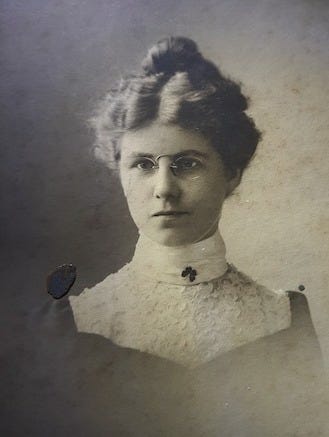
The Heaphys survived the Famine, but Youghal was so devastated by those years that its population shrank from about 11,000 in 1845 to just 5000 a generation later. In 1875, the Heaphys gave up on the town and emigrated to Boston. Mary Heaphy (see photo above), my great-grandmother, was part of that group. In 1892, she married John J. Farrell, my great-grandfather.
I visited Youghal last March/April. It was a fascinating trip. While in Youghal, I met with two community historians who were especially generous with their time and wisdom. They each gave me historical tours of the area and shared their understanding of local Famine history. It was a priceless experience.
Additionally, I visited the estates of several prominent Famine-era landlords and met their direct descendants. These families owned almost all of the land in the Youghal/Blackwater Valley area during the Great Hunger. I’m still trying to process what I learned about these folks. Of all the characters in this story, they’re the most complex.
Hopefully you can see what I’ve done here. In the paragraphs above, I give the reader the macro/micro narrative histories, a snapshot of my family history, and lastly a bit of travelogue.
That said, the most difficult part of this approach is going to be the family history. Without exception, I won’t know precisely how my ancestors fared during the Famine. There are no written records, and no oral histories either. For obvious reasons, no one wanted to talk about it. What I can do is paint an accurate picture of their local conditions, but as to their actual experience, I can only guess.
Thanks for this update, David! I'm really looking forward to reding more. I think your micro-macro approach makes a lot of sense, giving voice and individuality to those living and suffering through it.