
Spuds
Whoever says, “Irish Famine” says “Potato”. -Cormac Ó Gráda

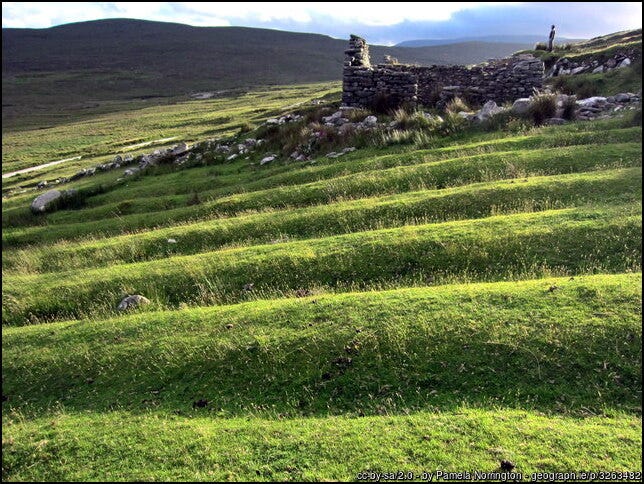
When the Great Famine started in late summer 1845, there were 8.5 million people in Ireland. The poorer half, some 4.7 million, depended on the potato as their main source of food. Of that 4.7 million, an estimated 3.3 million relied on spuds almost exclusively. Every day. All year.
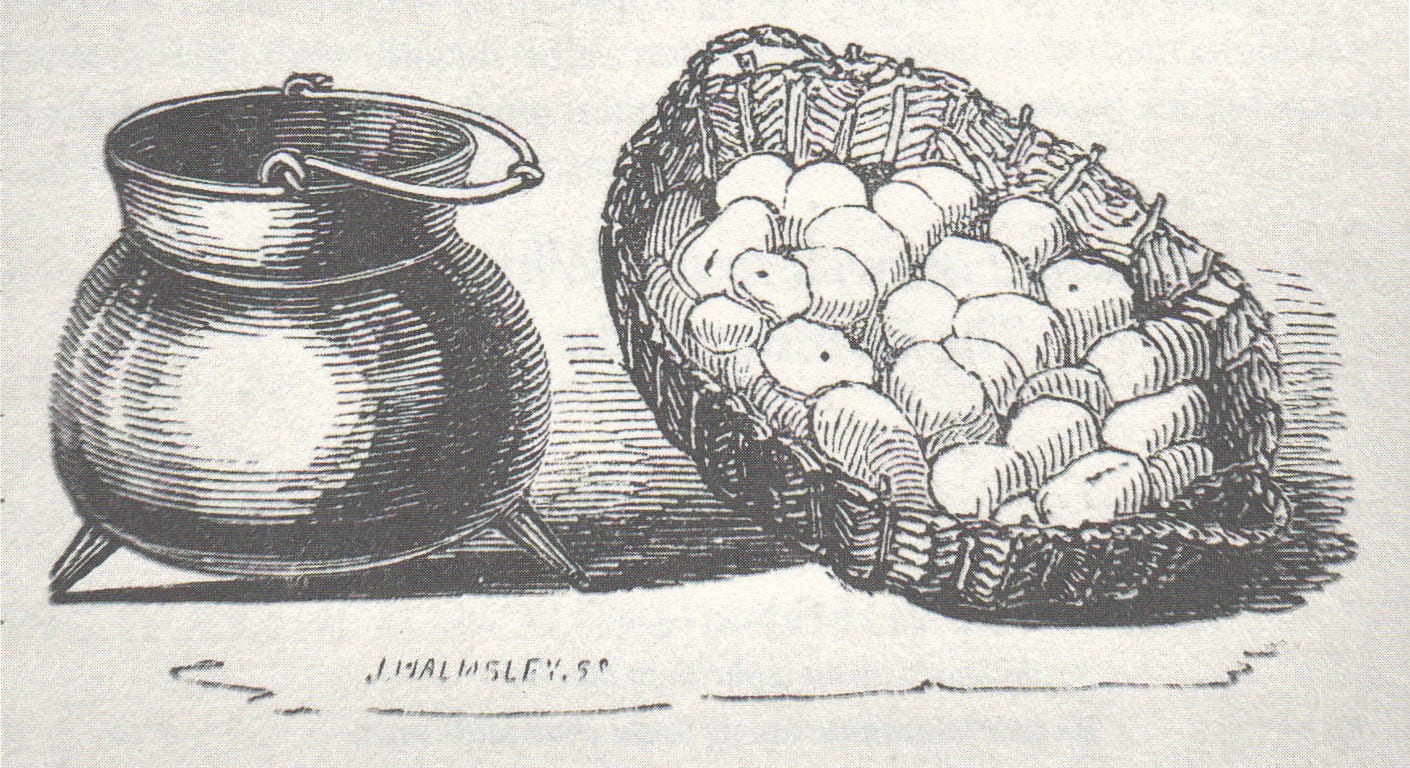
For the poor, preparation was simple. They boiled them. Seasoning consisted of salt and pepper, and in coastal areas, seaweed. Fish too, when available. When available, they washed it down with buttermilk.
In terms of serving size, it was enormous. Most historians agree that adult males ate between 12-14 pounds of potatoes daily. Women and children consumed less, but still an astonishing amount. Try imagining a 7 year old girl eating six pounds of potatoes in a single day.
Some scholars dispute the above numbers, claiming they’re “zombie” facts carelessly cited by historians that should know better. They argue that no human being could eat 12-14 pounds of potatoes, at least not regularly. Simply put, the human stomach can’t cope with that kind of volume.
I’m inclined to agree. Just for grins, I went to my local grocery store to see just how many potatoes were in a 12-14 pound daily portion. It was a lot. It took several attempts just to get them on the scale. At one point, there were spuds rolling all over the floor. The produce staff was not amused.
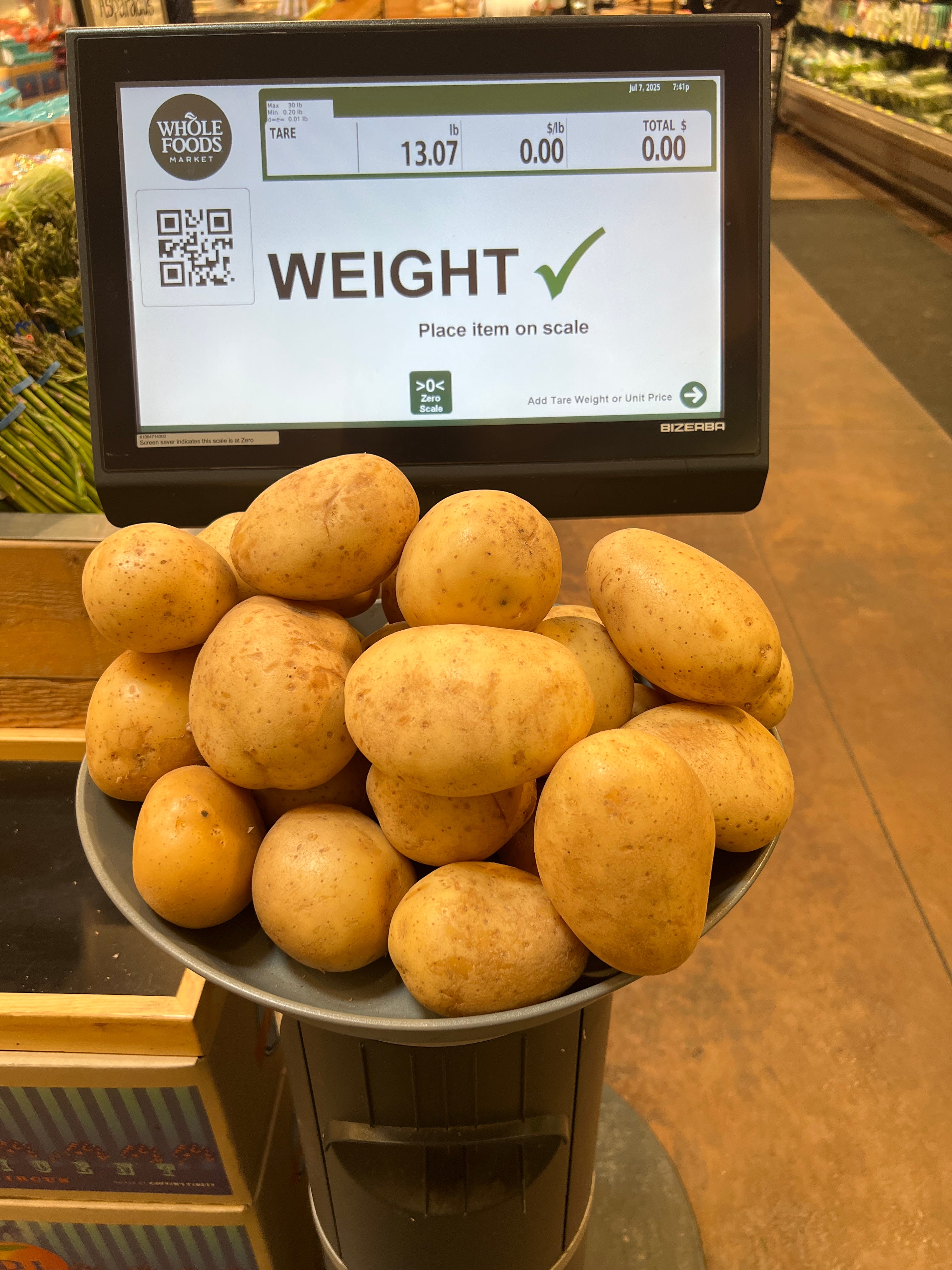
Speaking for myself, I couldn’t eat 12—14 pounds of potatoes in a day, much less every day, all year long. For comparison, in 2024, the average adult in the United States ate about five pounds of food per day. Add another seven pounds of spuds to that number, and you get the idea. But what is true, volume aside, is that potatoes and buttermilk combined were a complete meal for the rural Irish. It provided all the nutrients they needed to thrive.
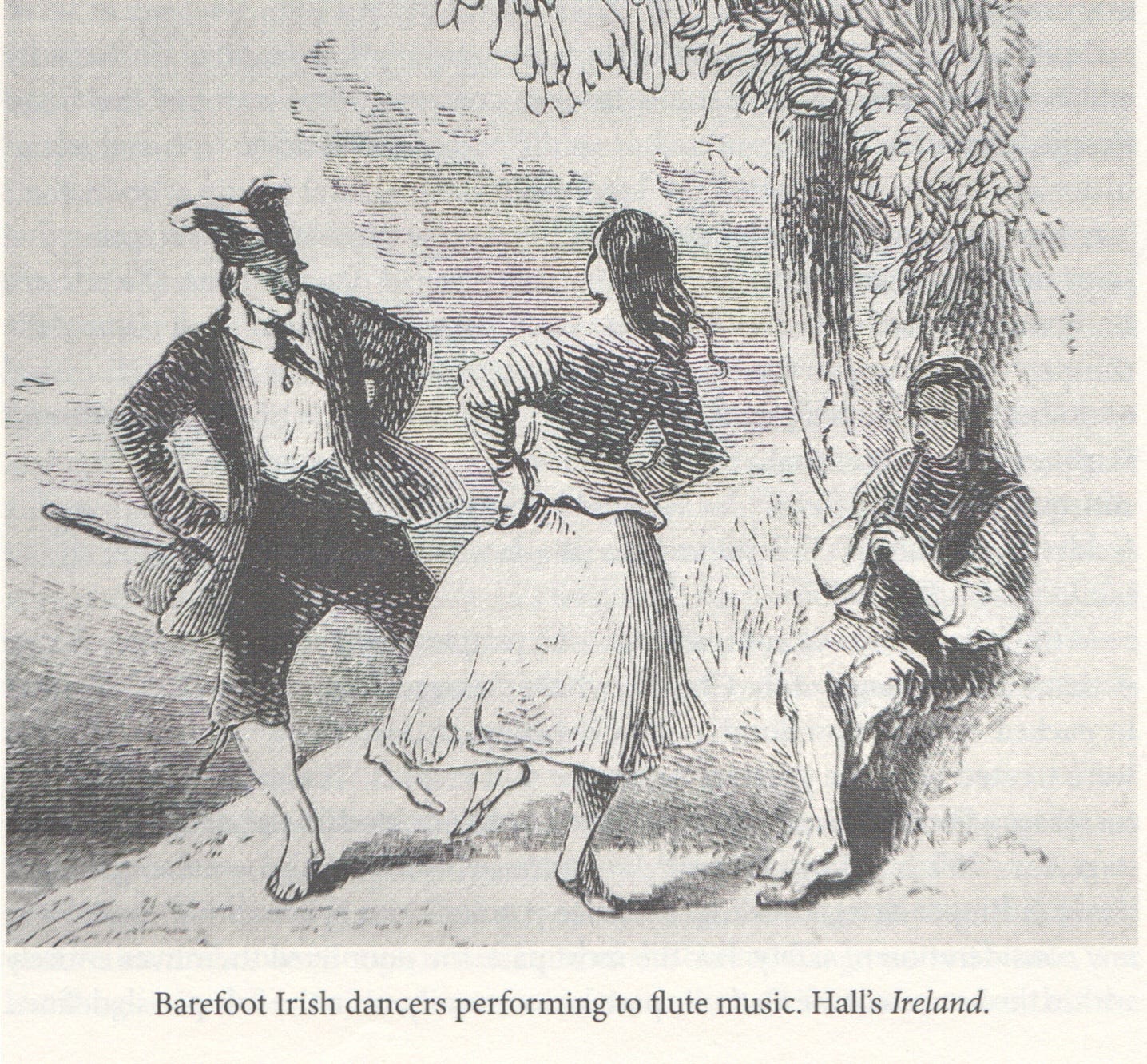
European travelers to pre-Famine Ireland noticed this vitality with a mix of amusement and confusion. Materially, the rural Irish appeared dirt-poor. Their housing was primitive and their clothing largely rags. But physically, they looked remarkably healthy, and they seemed to enjoy life immensely. They sang and danced with spontaneous gusto. They celebrated feasts and fairs with joyous abandon — and lots of strong drink.
The reason for this paradox was the potato. When abundant, it allowed the Irish poor to prosper in ways impossible to those living on a grain-based diet. To our modern sensibilities, potatoes and buttermilk for three meals a day, every day, sounds desperately monotonous. But to the rural Irish, it was manna from heaven.
So why only the potato? Weren’t there other options available to the Irish poor? The answer is yes. And no. It’s a little complicated, but stick with me here.
First, the rural Irish had virtually no control over the land. This was a direct result of over 600 years of British conquest, colonization, and confiscation. By the late 18th century, Irish Catholics, who were 80% of the population, owned just 5% of the land in Ireland. The rest was in British hands.
As a result, the rural Irish became a permanent underclass of tenant farmers and landless laborers. Tenant farmers typically grew cash crops, but low prices often made their produce nearly worthless. This meant they had to sell every bushel of grain and every last piglet just to pay rent. They were surrounded by food, often that they grew and raised, but they couldn’t afford to eat it.
Laborers generally negotiated agreements with landowners for the use of a small plot of manured land (for growing food) and a primitive cabin. In return, they paid rent, and pledged to work for the landowner for a set amount of days per year. Sometimes they earned wages too. The devil was in the details.
By the early 19th century the situation got more complicated. The Irish population had skyrocketed and competition for jobs and land grew intense. More people vied for a limited amount of work, and as a consequence, wages sank. The same dynamic caused rents to soar, as more people competed for a shrinking pool of available land.
In this situation, the rural Irish found themselves caught in a vise. Too often, after paying rent, selling crops, and collecting wages, there was little left over but debt. Survival should have been precarious under these circumstances, but the poor had a wild card: the potato.
In terms of yield per acre, nothing compared to the spud. For comparison’s sake, an acre of grain in pre-Famine Ireland produced an average 4,200 lbs of foodstuff in a growing season. That same acre could produce up to 20,000 lbs of potatoes. In a good year, an acre of potatoes could feed a family of 6 and their livestock, and still have plenty left over for charity.
Abundance like this meant more than full bellies. It also meant large families and vibrant communities. If the harvest failed, as it occasionally did in the pre-Famine era, hardship followed. But the distress was usually regional and temporary.
Still, it was clear to astute observers that the potato economy was a house of cards. In good times, it meant survival and then some. But it also left millions terribly vulnerable. That fragility became clear when the blight arrived in 1845. Most assumed it would be another short-term crisis. Times would be tough, but survivable. No one imagined it would last for seven horrific years.
Bibliography
Aubrey, Allison. “The Average American Ate (Literally) A Ton This Year.” The Salt. NPR, December 31, 2011. https://www.npr.org/sections/thesalt/2011/12/31/144478009/the-average-american-ate-literally-a-ton-this-year.
Dickson, David. Arctic Ireland: The Extraordinary Story of the Great Frost and Famine of 1740-41. White Row Press Ltd, 1998.
Engler, S., F. Mauelshagen, J. Werner, and J. Luterbacher. “The Irish Famine of 1740–1741: Famine Vulnerability and ‘Climate Migration.’” Climate of the Past 9, no. 3 (2013): 1161–79. https://doi.org/10.5194/cp-9-1161-2013.
Morton, John Chalmers. A Cyclopedia of Agriculture, Practical and Scientific: In Which the Theory, the Art, and the Business of Farming Are Thoroughly and Practically Treated. Blackie and Son, 1855. https://catalog.hathitrust.org/Record/008893984.
Murchadha, Ciarán Ó. The Great Famine: Ireland’s Agony 1845-1852. Bloomsbury Academic, 2013.
Ó Gráda, Cormac. Black ’47 and Beyond: The Great Irish Famine in History, Economy, and Memory. 1st paperback edition. Princeton University Press, 2000.
O’Keeffe, Helene. Why Was the Potato so Important? History. July 15, 2020. https://www.rte.ie/history/the-great-irish-famine/2020/0715/1153525-why-was-the-potato-so-important/.
Scanlan, Padraic X. Rot: An Imperial History of the Irish Famine. First edition. Basic Books, 2025.
“The Irish Land Questions - Where It All Began.” Accessed August 21, 2025. https://www.farmersjournal.ie/life/features/the-irish-land-questions-where-it-all-began-744575.