
"Orange Peel"
An Introduction

One of my favorite binge watches at the moment is a modern day police drama set in Belfast, Northern Ireland, called Blue Lights. I’m a sucker for international shows these days. The national news is so bleak, any chance to travel elsewhere is welcome, even if it’s just streaming BritBox in my basement. Blue Lights isn’t exactly a feel-good show like Ted Lasso, but the good guys usually win, and these days, that’s refreshing.
In one episode, Annie Conlon, a young officer in the PSNI (Police Service of Northern Ireland), loses her mother to cancer and is home attending her wake. This is a dangerous act. A dissident IRA gang is shooting PSNI officers on sight. Annie isn’t safe anywhere, even at her mother’s funeral.
But she goes anyway, and in support, police HQ sends a veteran officer, Sgt. McClosky, to guard her. At the wake, he stands outside the front door and glowers at mourners while he eats finger sandwiches off a paper plate. Eventually, Annie’s Aunt Bea comes out with some fresh sammies, hands them to McClosky, and says anxiously, “Why don’t you come inside. You look like a Peeler standing there.” With a deadpan look and tone, McClosky replies, “I am a Peeler.”
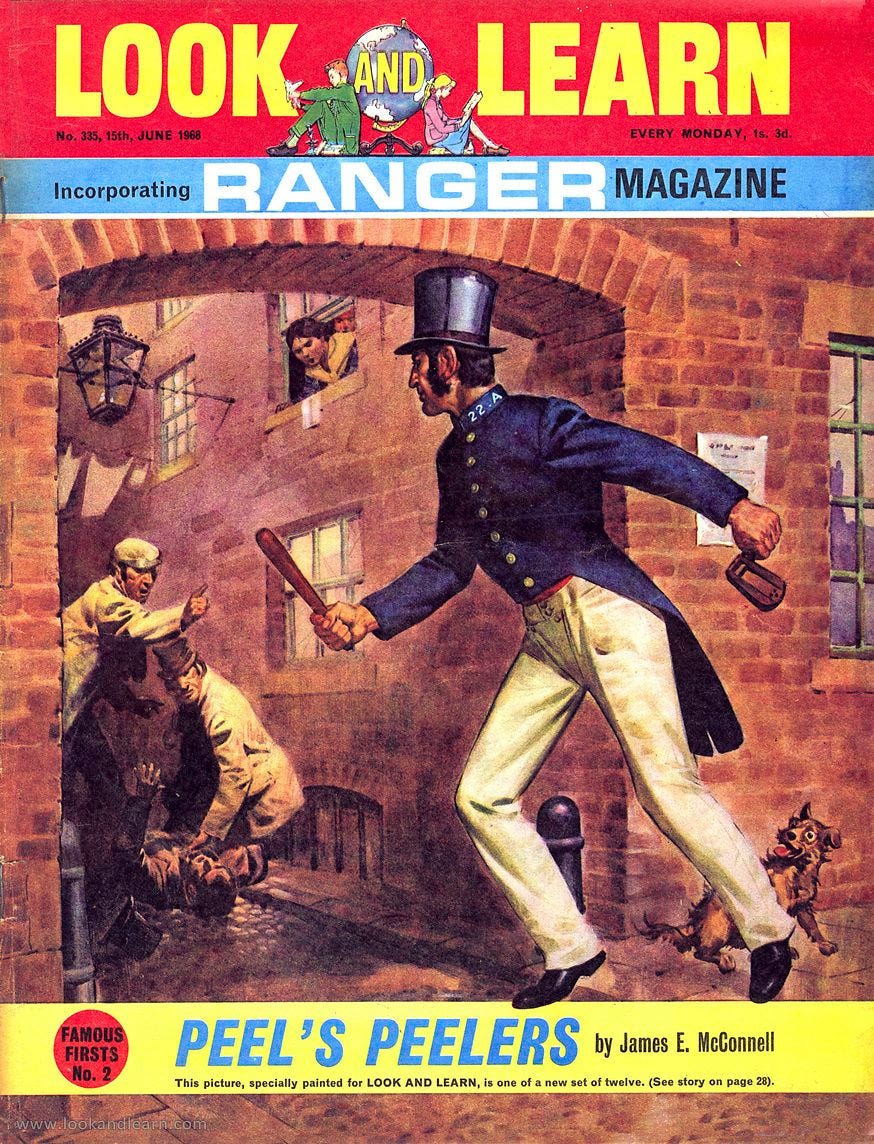
A Peeler. What’s a “Peeler”? In short, it’s a nickname for British policemen in Ireland that traces back to 1814, when the Chief Secretary of Ireland, Sir Robert Peel, convinced Parliament to pass the Peace Preservation Act. The new law established a local Peace Preservation Force that later evolved into the Royal Irish Constabulary. The Irish quickly dubbed the new cops “Peelers.” The name has stuck to this day.
But Sir Robert Peel’s legacy in Ireland extends far beyond policing. He was also Prime Minister of Great Britain when the Great Hunger began. His policies were controversial, and still are, and they ultimately cost him his premiership.
When the blight appeared in the suburbs of Dublin in August of 1845, there was no general alarm among farmers and government authorities. This subdued reaction was due to both hopes for a localized blight and a legitimate reluctance to induce panic. Further, the plants, at least above ground, appeared normal. Only when the rotten tubers were dug out of the soil was the scope of the devastation clear. By October, authorities agreed that roughly 40% of the potatoes had been destroyed.
At the time, more than three million Irish were completely dependent on the potato for subsistence. These people were the poorest of the poor in Ireland. Another large portion of the population was partially dependent on spuds. The rest ate potatoes regularly, even at the highest levels of society.
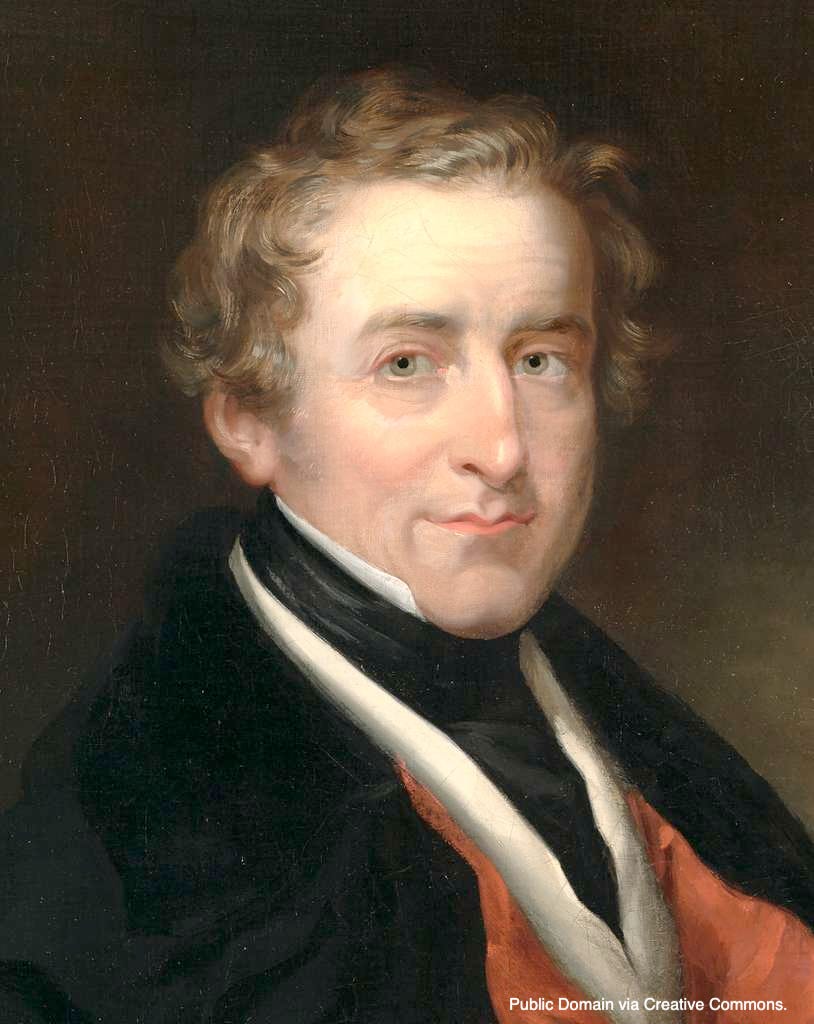
Sir Robert Peel, while recognizing the implications of the crop failure, reacted slowly to the news. Peel had extensive experience in Irish affairs. He had been Chief Secretary for Ireland from 1812-1818, and while he was initially opposed to Catholic Emancipation, he eventually came around, but only on the grounds that failure to do so would cause unacceptable civil unrest. Daniel O’Connell, dubbed him “Orange Peel” for his wishy-washy stance on this issue. Peel was furious, and never forgave him for the taunt.
Regardless, Peel was an intelligent, capable man and widely respected in his day. Though clearly his personal feelings toward the Irish were mixed, he had a clear sense of duty to the island and its people. Still, he considered the Irish a feckless people with a tendency toward exaggeration, and as such, he preferred to take a “wait and see” approach to the crisis even as he began planning limited relief measures behind the scenes.
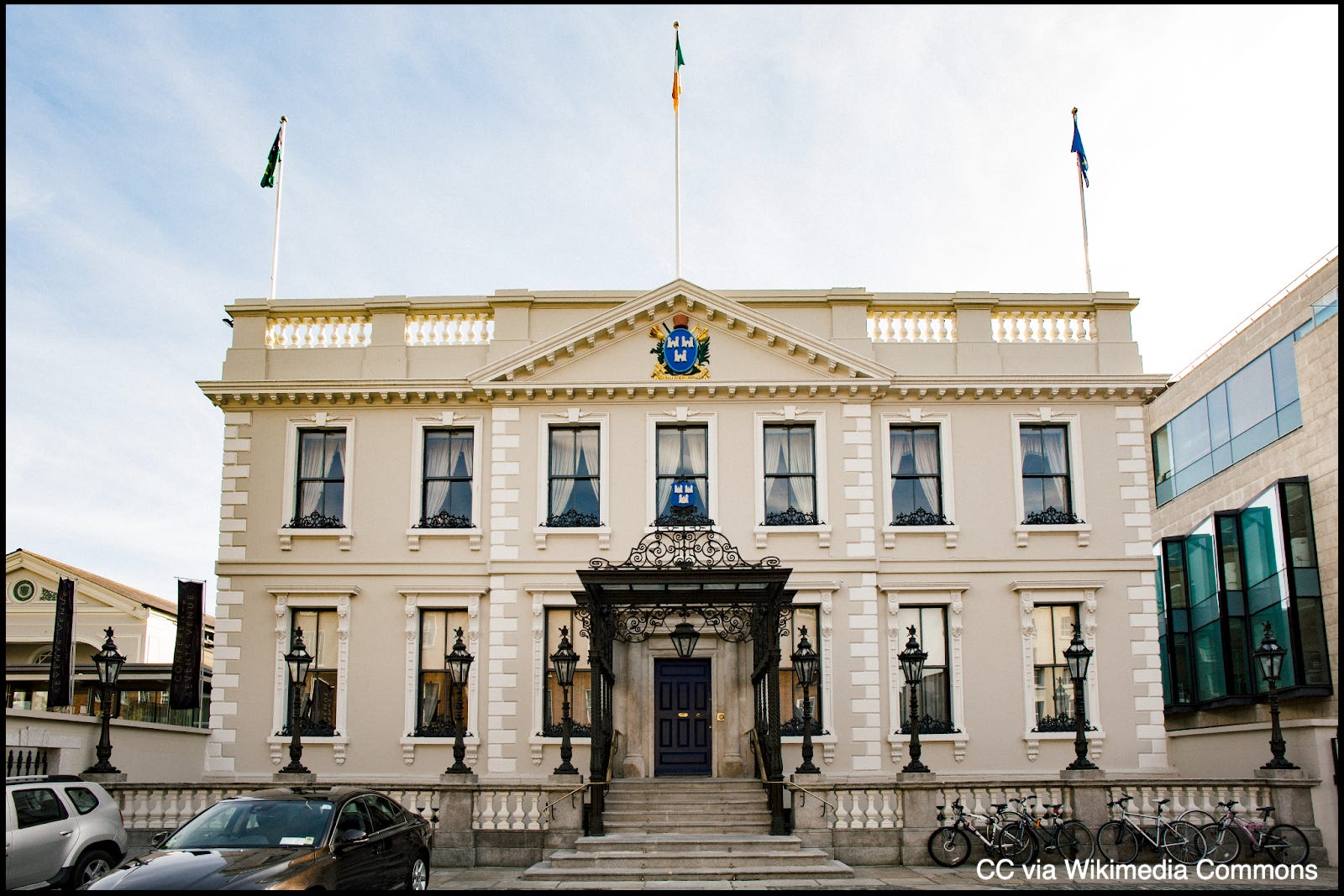
This cautious approach didn’t work for the Irish. Rather than waiting for Peel, leading citizens in Dublin took it upon themselves to act. In October of 1845, they formed the Mansion House Committee. The goal of this group was to assess the looming subsistence crisis and recommend appropriate responses. The result was a list of suggestions for vigorous government action.
First, they recommended a national public works system so those most impacted by the blight could earn money to buy food. Second, to create adequate supply and keep prices low, they proposed both an increase in grain imports coupled with a stoppage on all grain exports. In other words, keep Irish food in Ireland. Third, local grain usage for whiskey distilling and beer brewing would be temporarily halted. Lastly, the committee recommended a substantial government loan (around £1.5 million) to buy food and subsidize prices to keep food affordable. All of this would be funded by loans from the British Treasury. Repayment would be rendered by revenue generated by timber sales from the Irish Commission on Woods and Forests.
These were not radical suggestions. They had precedent derived from the British government’s responses to previous food shortages in Ireland. However, by 1845, laissez faire economics, known at the time as “political economy,” had taken on a cult-like devotion by majorities of both major political factions in Great Britain. In short, this philosophy demanded a hands-off approach to the country’s economic affairs. Any government intervention was seen as too much. As one historian wrote, “Starvation, as it turned out, was preferable to intrusion in the market place.” More on this later.
As such, the British government’s response to the Mansion House Committee’s was brief and to the point. No thanks. They had a plan. They had already assembled a deputation of the best “scientific men” to tour the Irish countryside to determine the depth and breadth of the blight. Until they reported in, there was no point in engaging in such meddling.
In any case, given the political zeitgeist of the times, such a massive intervention seemed unlikely. Laissez faire required the market to sort out the supply and demand problems of the crisis, and Peel was a devotee. But he was above all, a pragmatist, and his government’s response to the 1845 potato crop failure would surprise, and infuriate, his friends and foes alike.
Sources
How the Blight Spread: An Interactive Map. History. November 16, 2020. https://www.rte.ie/history/famine-ireland/2020/1116/1178464-how-the-blight-spread-an-interactive-map/.
Kinealy, Christine. This Great Calamity: The Irish Famine 1845-52. UNKNO, 1995.
Kinealy, Christine, Gerard Moran, and Jason King, eds. The History of the Irish Famine. Routledge, 2019.
Murchadha, Ciarán Ó. The Great Famine: Ireland’s Agony 1845-1852. Bloomsbury Academic, 2013.
Powderly, William G. “How Infection Shaped History: Lesson From the Irish Famine.” Transactions of the American Clinical and Climatological Association 130 (2019): 127–35.
Woodham Smith, Cecil. The Great Hunger: Ireland 1845-1849. With Internet Archive. New York, Harper & Row, 1962. http://archive.org/details/greathungerirel00wood.
Great piece.
Some added Peel stuff
He is the reason they are called Bobbie’s (short for Robert)
They were deliberately created a a civilian force not to be part of the army and that is why they used not to carry guns.
He was PM and a laissez faire supporter and that led to him repealing the Corn Laws which had imposed tariffs on all imported grain starting in 1815. This meant that English landowners could charge higher prices for their grain as there was limited competition. The impetus for the repeal was the potato famine (but the British government was slow to react and even then, the Conservative Party (to which Peel belonged) split over this legislation.