
God's Will
Ideological Manslaughter Part One: Providence and the Great Hunger

The Almighty, indeed, sent the potato blight, but the English created the famine.” John Mitchell-1861
On March 6, Secretary of Defense Pete Hegseth told CBS News, “The providence of our almighty God is there (Iran) protecting those troops.” Later during a Pentagon prayer meeting, he beseeched God to, “Grant [our soldiers] clear and righteous targets . . . . and overwhelming violence of action against those who deserve no mercy.”
Clearly Hegseth believes that God’s will drives history, and the Iran War has given him a bully pulpit to present the evidence.
Hegseth’s brand of Providentialism isn’t unique. Throughout history, religious fanatics of various stripes have used versions of Providentialism as a deterministic catch-all to explain God’s governance of events big and small. The British government’s response to Ireland’s Great Famine is a particularly tragic example.
For instance, in October of 1845, when it was clear that at least 40% of the potato crop was destroyed, Sir Robert Peel, the British PM, appointed a scientific commission to investigate the causes of the blight and to recommend interventions to save what was left. The Commission head, botanist John Lindley, was pessimistic. He knew the blight spread and killed at an astonishing speed, and he understood the implications: much of the poor’s food for the coming winter would be lost.
Lindley saw little hope for a solution. He wrote, “As to cure for this distemper there is none . . . . Man has no power to arrest the dispensations of Providence. We are visited by a great calamity which we must bear.”
As the crisis intensified, Providentialist interpretations went beyond Lindley’s determinism to embrace divine judgements for a litany of Irish blasphemies. Such is the flexibility of Providentialism. It’s a doctrinal grab bag the practitioner can use to not only explain calamitous events, but also cast a verdict on the afflicted peoples and prescribe punishments for their sins. And Ireland had a plethora of sins that needed punishing.
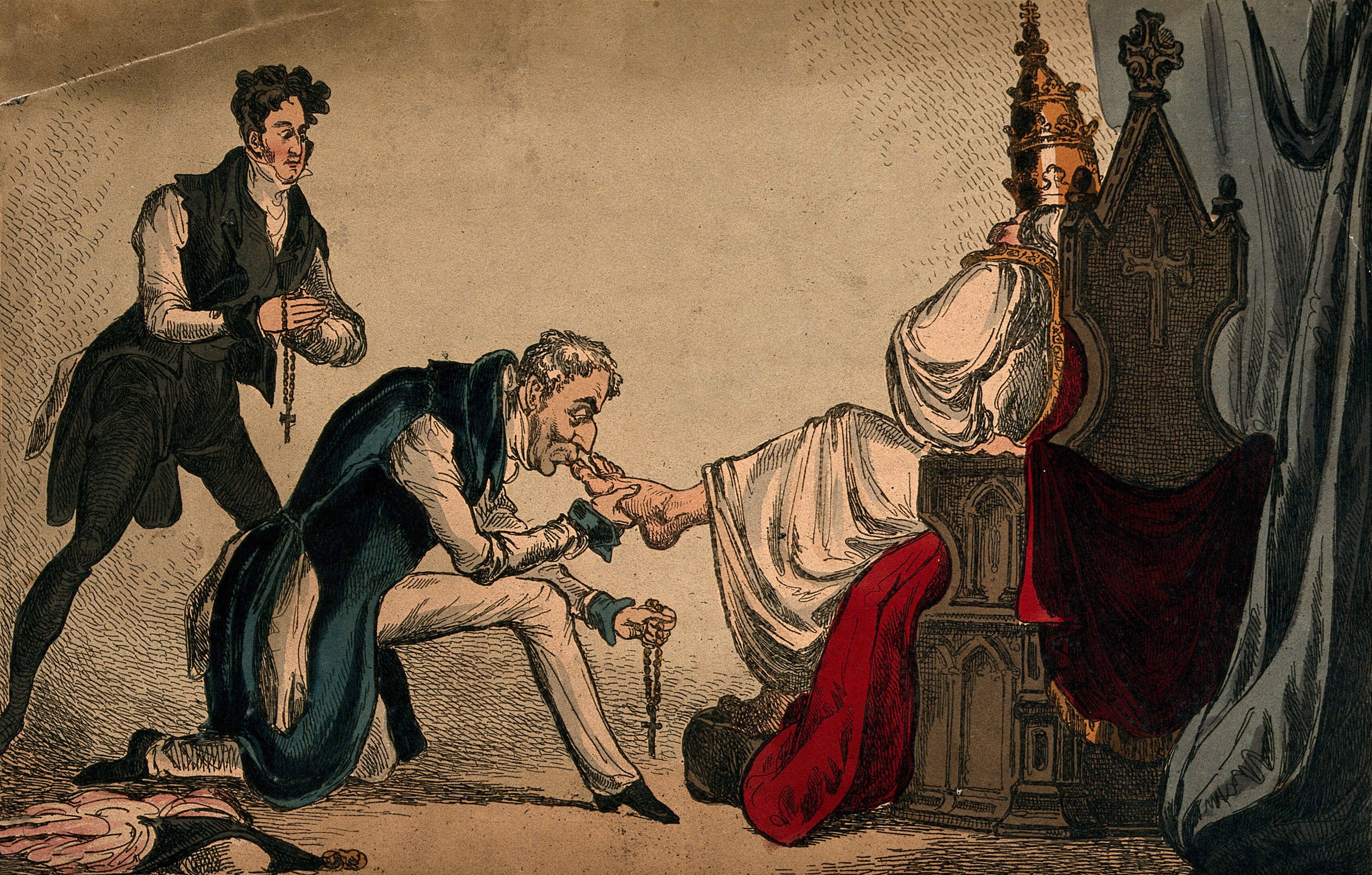
For some, Ireland’s most enduring wickedness was its Catholicism. In the 21st century, it’s hard for us to wrap our heads around this kind of religious bigotry. After all, Catholics and Protestants are both Christians, so no problem.
So why the hatred? In short, most Protestants considered Catholicism, with its ornate cathedrals, emotional statues, and arcane rituals to be a primitive, paganistic cult that repeatedly violated the Bible’s 2nd Commandment against idolatry. Further, the more radical Protestant sects considered the Pope to be a living incarnation of the Anti-Christ.
And the Irish weren’t the only blasphemers. This flavor of Protestantism considered the British government equally sinful. After all, it had approved Catholic emancipation, in 1829, which ended legal anti-Catholic discrimination in the British Empire. These true believers considered this tantamount to surrender to Rome, and for many, the only hope for atonement was to use the Famine as an instrument of Providence to weaken Catholicism’s hold on the spiritually misguided Irish.
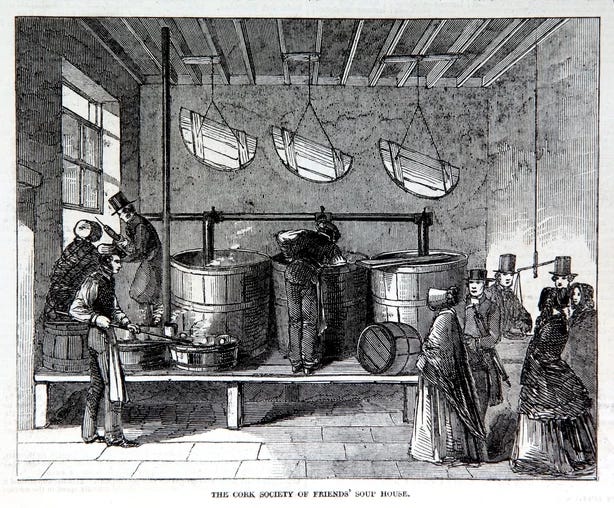
That said, there were Protestant sects that weren’t all vitriol and spite. Some saw the Famine as an opportunity to practice “good works” that Jesus taught in the Gospels. The “Quakers”, or Society of Friends, embodied this ideal more than any other Protestant denomination during the Famine. Unlike their brethren who saw the Famine as an opportunity to crush Catholicism, the Quakers’ charity was unconditional. They asked the question WWJD, and answered with kindness and love.
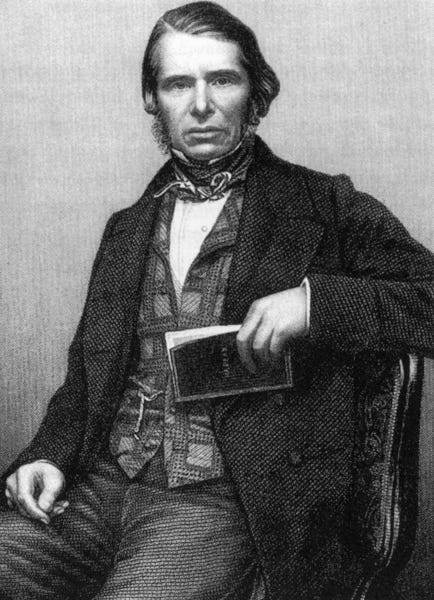
Still, the Quakers were in the minority. Hard-line Providentialism dominated government thinking throughout the Famine years. The British ruling class, in particular, saw the crisis as an opportunity, presented by God, to reform Irish society from the ground up. Treasury official Charles Trevelyan wrote in 1846 that the blight was “the cure” for Ireland’s “deep and inveterate social evils” and had been “applied by a direct stroke of an all wise providence”.
The mechanism for this cure was the relatively new economic philosophy of “political economy” known in our time as “laissez-faire”. The British ruling elite saw this doctrine as the perfect secular spouse to their Providentialist theology, and it would drive their policy choices moving forward. This coupling was a marriage from hell, and the consequences would be horrific for the Irish poor.
Sources
Boyle, Phelim P., and Cormac Ó. Grádo. “Fertility Trends, Excess Mortality, and the Great Irish Famine.” Demography 23, no. 4 (1986): 543–62. https://doi.org/10.2307/2061350.
Donnelly, James S. The Great Irish Potato Famine / James S. Donnelly, Jr. Sutton Publishing, 2001. Ucb.fa9d4129.ab53.5811.a70c.c5f790e9988b.
Jaffe, Greg, and Elizabeth Dias. “Hegseth Invokes Divine Purpose to Justify Military Might.” U.S. The New York Times, March 20, 2026. https://www.nytimes.com/2026/03/20/us/politics/hegseth-christianity-military.html.
Large, E. C. The Advance Of The Fungi. 1946. http://archive.org/details/in.ernet.dli.2015.202161.
Murchadha, Ciarán Ó. The Great Famine: Ireland’s Agony 1845-1852. Bloomsbury Academic, 2013.
The Irish Famine : A Documentary History / [Compiled and Edited by] Noel Kissane. National Library of Ireland, 1995. Ucb.4fa3eedd.7024.5893.83a9.d82a94cde828.
Excellent! And heartbreaking. The quote really focuses the piece.
Also, does no one else think Charles Trevelyan looks a bit like Hegseth - the flat, bullying aspect, the mismatched eyebrows?
Just me? :)
Brilliant piece of writing - thank you Dave Farrell.