
Blight
The Super Pathogen that Crushed Ireland

What is Blight?
In The Last of Us, the blockbuster HBO series, cordyceps, a family of parasitic fungi, makes a climate-change induced jump from colonizing insects to humans, turning hosts into fungi-zombies. The result is a horrifying scenario where the infected hunt the survivors, who in turn battle both the monsters and each other. It’s great sci-fi, but not for the squeamish.
Several years before the show’s release, writer/photojournalist John Reader penned Potato: A History of the Propitious Esculent. When describing potato blight, he wrote,
“If we imagine our lungs and digestive systems being destroyed by loathsome growths that sent weird and colorless seaweeds issuing from our mouth and nostrils, tipped with pustules that then burst to spread their evil infection among our neighbors, [then] we have a crude idea of how a potato plant felt when its leaves were moldy with blight.”
John Reader could have been a staff writer for The Last of Us when he wrote the above.
Unfortunately, An Gorta Mór was not fictional. It was a real-life apocalypse for both the Irish potato crop and the poor that depended on it for survival. In this case the pathogen wasn’t cordyceps, but a fungus-like organism called Phytophthora infestans (or P. infestans). P. infestans is an oomycete, which is not solely a fungus, but rather a relative to both fungi and algae.
While classified as “late blight” (there is an “early blight”disease) that’s a misnomer. In reality, P. infestans can happen at any time during the growing season. It favors cool, wet conditions, which is pretty much Ireland’s weather year round. Once unleashed, it spreads and destroys at an almost supernatural speed.
How Does It Spread?
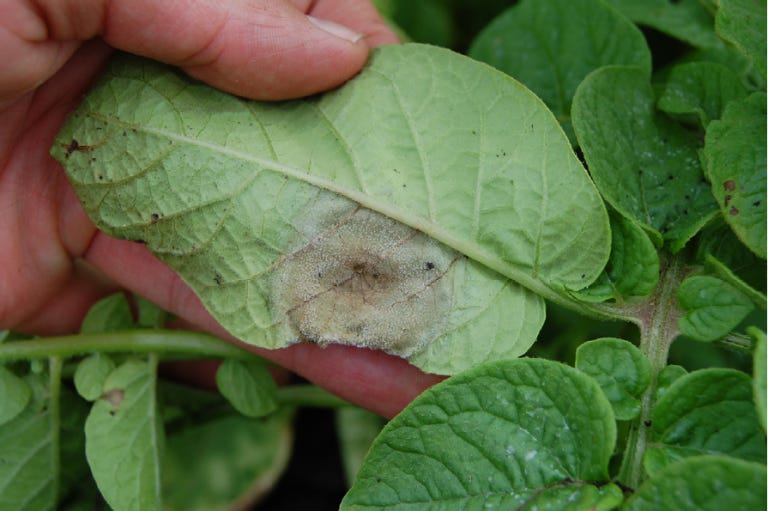
It begins with a single spore that punctures the surface of a healthy leaf via a germ tube. Very quickly, snake-like filaments called hyphae form. These filaments feed off nutrients in the leaf’s cells causing them to die and turn black or brown. When enough cells die, tell-tale black or brown lesions spread across the surface of the leaf. These lesions are usually the first visual sign of blight.
As the disease progresses, a white, downy substance spreads across the underside of the leaf. This is a dire sign. It means that those snake-like filaments have finished wreaking havoc in the leaf’s interior and have resurfaced on its exterior through the leaf’s stomata or breathing holes. Once outside the leaf again, the filaments form sporangia, which are like microscopic spore trees. Each branch on sporangia is tipped with a spore pod. These pods then release their spores into the wind or rain, ready to infect a new host.
Infected leaves usually have multiple lesions, each of which can release up to 300,000 spores per day. Death comes quickly to an infected plant, usually within five days.
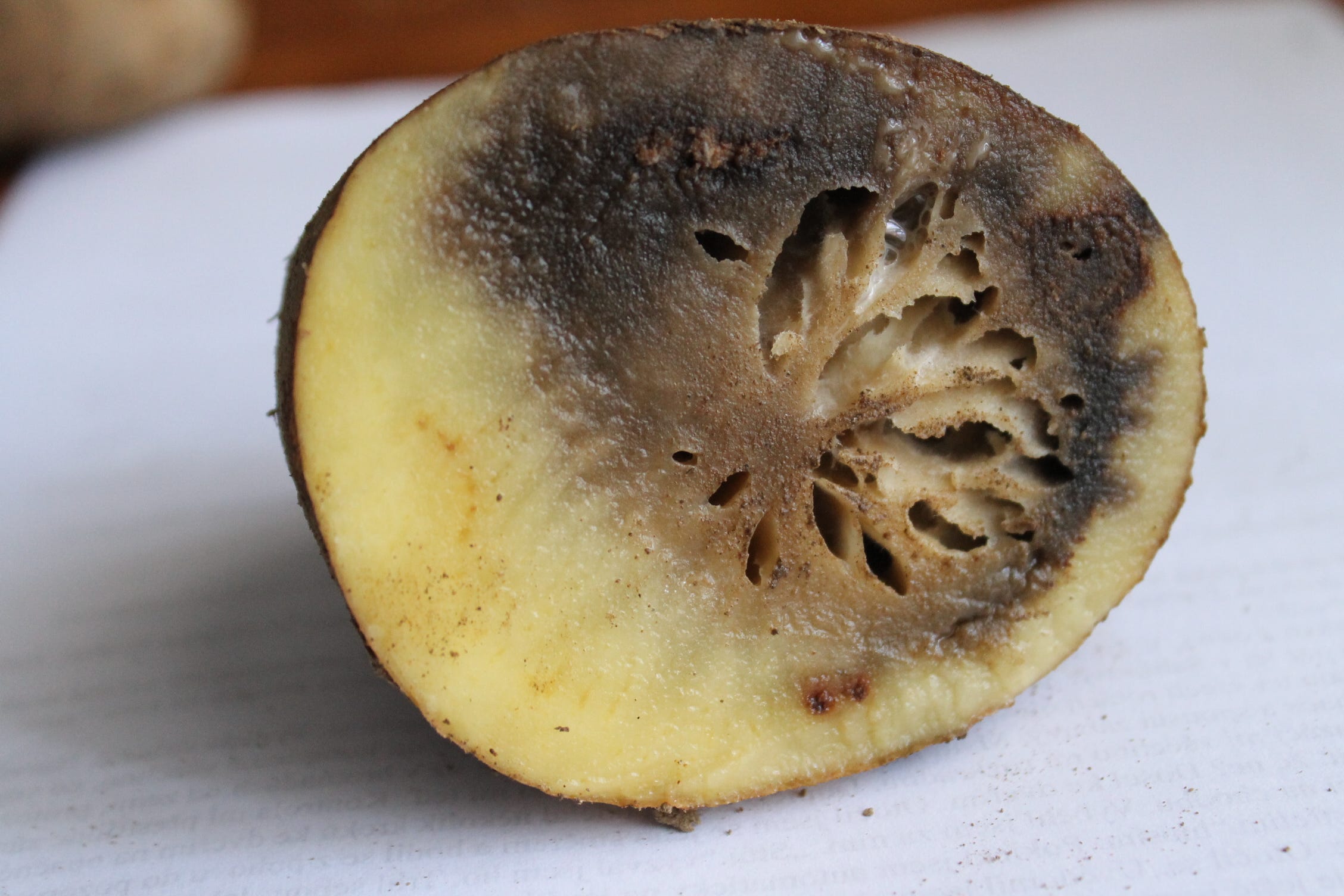
Tubers (potatoes) are usually infected by spores washing into the soil via rain and moisture. Secondary infection from bacteria is what turns them into the black, pungent mush so infamous during the famine. (For those interested, this video does a nice job visually describing blight’s infection cycle described above.)
You see the problem here. One infected plant, one infected potato, or one spore from any source, can wipe out an entire crop. Not just in one field, but in an entire country. Cold, moist conditions put the blight’s reproductive cycle into overdrive. Ireland never had a chance.
How Did Blight Get To Ireland?
Thanks to DNA samples of European potatoes from the 1840s, scientists now know that the blight that crushed Ireland originated in the Toluca Valley in Central Mexico. How it got to Europe and ultimately Ireland is unclear. It could have been a single spore, a single potato, or a cargo of tubers from the Americas. This was during the steam revolution, and steam-powered ships had made the world smaller.
What we know for sure is that the blight appeared in the northeastern U.S. as early as 1843, and by 1844 it had spread to New England and northeastern Canada. By late June of 1845, it had crossed the Atlantic and was in Belgium. A month later, it struck the Netherlands.
The devastation was swift and brutal. 71% of the Belgian potato crop was destroyed, along with 88% of the Dutch crop. Up to 300,000 died in Belgium and the Netherlands as a result. This part of Europe had experienced a cold, wet summer, and like Ireland, had large amounts of poor farmers and laborers that depended almost completely on spuds for food.
By mid-August of 1845, the blight was in Southern England. On the Isle of Wight, T. Bell Salter, a local doctor, reported to the Gardener’s Chronicle and Agricultural Gazette on what he called “blight of unusual character which almost universally affects the potatoes in this island.” He offered one of the first eye-witness descriptions of the progression of this disease. First, the leaves turned black, moving along to the stems and within three days the upper part of the plant was completely dead.
Below the ground, the tubers (the part we eat) had a similar progression. Black spots appear first, “much resembling a severe burn.” As the disease spread, the potato turned completely black and soft, disintegrating as it was pulled from the ground. The remnants had a “pungent and noxious taste” and if used as feed, reportedly killed pigs and other livestock.
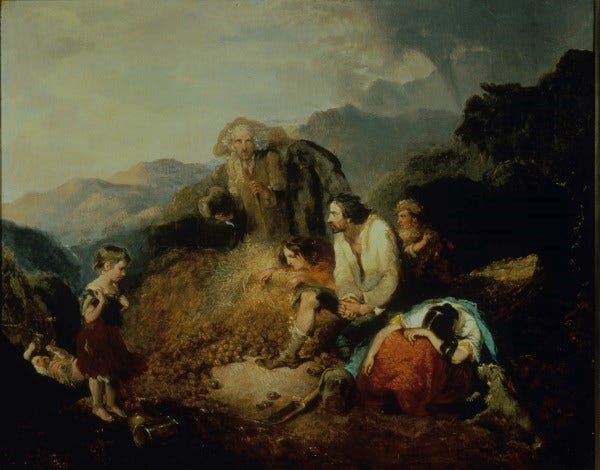
Prophetically, Dr. Salter warns the readers of the Gazette that “So universal is the evil, that the consequences are likely to be very serious. . . I have this day watched every potato ground as I passed along, and not one I could see uninjured.” By the end of August the blight appeared in the suburbs of Dublin. An Gorta Mór had begun.
Bibliography
Bourke, Austin, Jacqueline R. Hill, and Cormac Ó Gráda. The Visitation of God?: The Potato and the Great Irish Famine. Lilliput Press, 1993.
Goss, Erica M., Javier F. Tabima, David E. L. Cooke, et al. “The Irish Potato Famine Pathogen Phytophthora Infestans Originated in Central Mexico Rather than the Andes.” Proceedings of the National Academy of Sciences of the United States of America 111, no. 24 (2014): 8791–96. https://doi.org/10.1073/pnas.1401884111.
How the Blight Spread: An Interactive Map. History. November 16, 2020. https://www.rte.ie/history/famine-ireland/2020/1116/1178464-how-the-blight-spread-an-interactive-map/.
Reader, John. Potato: A History of the Propitious Esculent. Yale University Press, 2009.
Ristaino, Jean Beagle. “Tracking Historic Migrations of the Irish Potato Famine Pathogen, Phytophthora Infestans.” Microbes and Infection 4, no. 13 (2002): 1369–77. https://doi.org/10.1016/S1286-4579(02)00010-2.
Scanlan, Padraic X. Rot: An Imperial History of the Irish Famine. First edition. Basic Books, 2025.
The Gardeners’ Chronicle and Agricultural Gazette. Vol. 1845. Published for the proprietors, 1845. https://www.biodiversitylibrary.org/item/101659.
This is brilliant, well presented and disturbing. The personification of what the disease is like is chillingly effective.
Fantastic writing Dave! The stuff of nightmares but awesome!